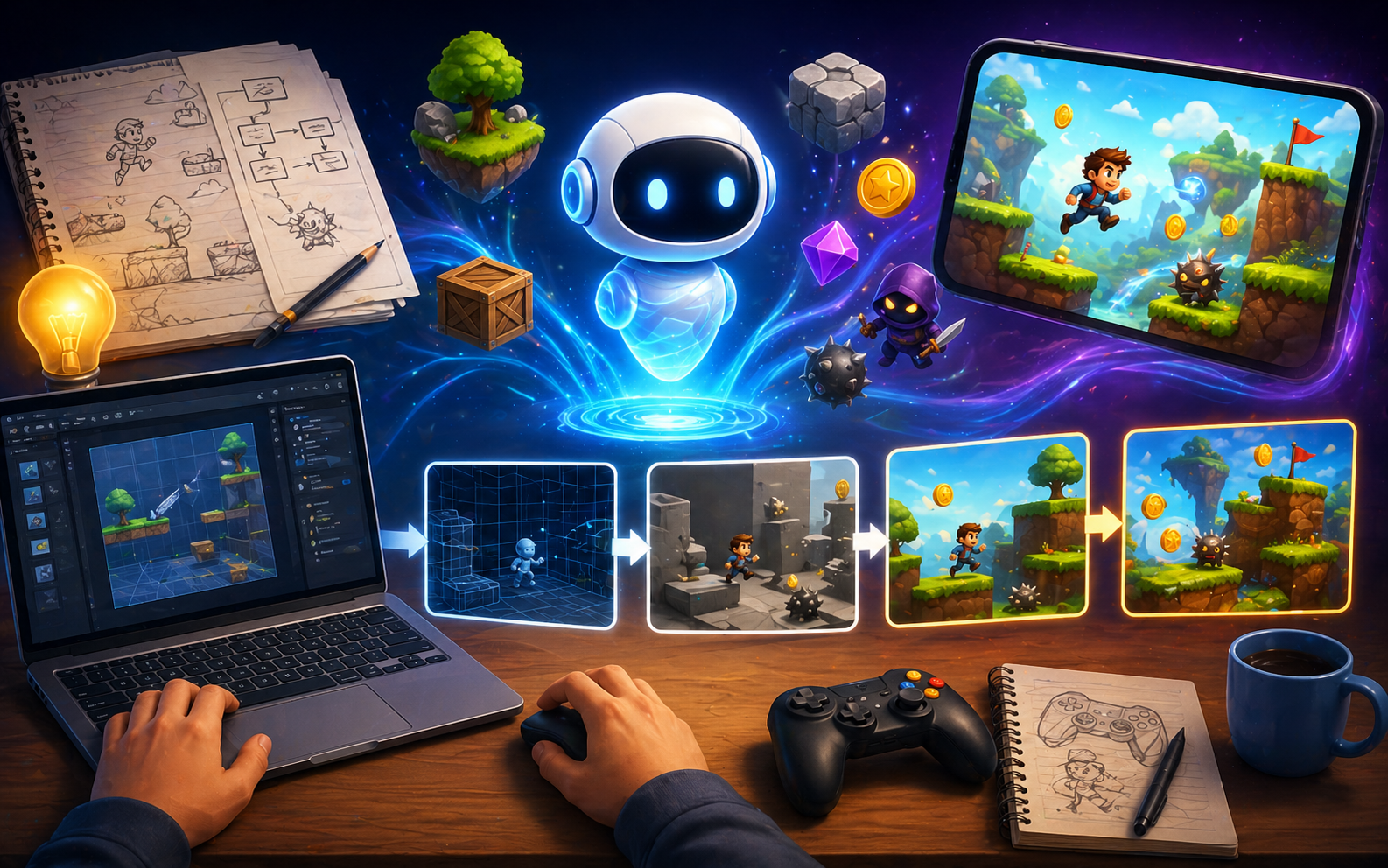

Game development has gone through a major shift in recent years as tools powered by artificial intelligence have made it possible for anyone to create games without writing code. What once required technical skills and long development cycles can now begin with a simple idea written in plain language. This change has opened opportunities for beginners who have creativity but no programming background. Instead of focusing on complex systems you can now focus on the experience you want to create. Many AI game platforms are making this process easier by allowing creators to turn written prompts into playable results within a short time. This means the barrier to entry is lower but the need for clear thinking and structured ideas is still important because the system depends entirely on what you describe.
What It Means to Build a Game Using AI Prompts
Building a game using AI prompts means guiding the entire development process through instructions written in natural language instead of code. You define the type of game, the actions of the player, and the rules that control the experience. The AI interprets these instructions and creates a working version that you can test and improve. This approach changes your role from someone who builds systems manually to someone who shapes ideas and refines gameplay. The outcome depends on how clearly you explain your concept because the system can only generate what it understands. This makes clarity and structure the most important parts of the process and encourages you to think more about design than technical execution.
Why AI Game Creation Is Growing So Fast
AI game creation is expanding rapidly because it solves many problems that made traditional development difficult for beginners.
- Anyone can start without coding knowledge or technical experience
- Ideas can be turned into playable versions within a short time
- Creators can experiment with multiple concepts and improve quickly
These advantages allow more people to enter game development and learn by doing rather than spending months on theory which leads to faster progress and more creative exploration.
Choosing the Right Idea Before You Start
Every game begins with an idea but not every idea works well for beginners. The most effective approach is to start with something simple and clear that focuses on one main action. Many new creators try to build complex systems too early which leads to confusion and unfinished projects. A simple concept such as avoiding obstacles or collecting items is easier to build and easier to test. It also helps you understand how gameplay works before adding more layers. When your idea is simple you can focus on improving how it feels instead of struggling to manage multiple mechanics at once. This approach builds a strong foundation and allows gradual expansion without losing clarity.
Writing Prompts That Actually Work
The prompt is the foundation of your game and it determines how well the AI can translate your idea into a playable form. A good prompt is clear, structured and focused on one aspect at a time. Instead of trying to describe everything at once you should build your game step by step by starting with the main mechanic and then adding features like scoring, difficulty and progression. This layered approach gives you more control over the result and makes it easier to fix issues because each part is added intentionally. When your prompts are clear the system produces more accurate results and the overall development process becomes smoother and more predictable.
Turning Your Prompt into a Playable Game
Once your idea is clear and your prompt is ready you can generate your first playable version, which is the stage where your concept becomes something interactive. This initial version is not meant to be perfect but it allows you to experience how your idea works in practice and identify what needs improvement. Modern AI game platforms allow you to move from idea to playable version quickly, which reduces the time spent on setup and increases the time spent on refinement. At this stage, your focus should be on observing how the game feels rather than trying to polish everything because early feedback is what guides better decisions in later stages.
Improving the Core Gameplay Experience
The core gameplay is the most important part of your game because it defines what the player does repeatedly and determines whether the experience feels enjoyable. If the core loop is weak players will lose interest regardless of how good the visuals look. Improving this part requires attention to detail such as making movement smooth ensuring actions respond instantly and providing clear feedback for success or failure. Even small adjustments can change how the game feels and increase engagement significantly. When the core gameplay is satisfying players are more likely to continue playing and explore what the game has to offer.
Learning from a Simple Game Example
One of the best ways to understand effective game design is by looking at simple examples that focus on a single strong mechanic. A game like Space Runner shows how avoiding obstacles combined with increasing speed can create a challenging and engaging experience without unnecessary complexity. The player always understands the objective and the progression feels natural which keeps the experience consistent and enjoyable. This type of design highlights the importance of clarity and balance where the game becomes more difficult over time without overwhelming the player. It demonstrates that a well executed simple idea can be more effective than a complex system that lacks focus.
Common Mistakes to Avoid
- Starting with ideas that are too complex to manage
- Writing prompts that are unclear or too broad
- Focusing only on visuals while ignoring gameplay feel
- Skipping testing and assuming the game works correctly
Avoiding these mistakes helps you stay focused on what matters and improves your ability to build better games over time.
See also: Dominique Rogeau Exploring a Name Linked With Modern Professional Identity
Adding Depth Without Making It Complicated
Once your game is working you can begin adding depth in a way that enhances the experience without making it confusing. This means introducing new challenges gradually increasing difficulty and adding rewards that motivate players to continue. The goal is to make the game more engaging while maintaining clarity so players always understand what they are doing. Balance plays a key role because too many changes at once can make the game overwhelming, while too few changes can make it repetitive. By improving the game step by step you create a more enjoyable experience that evolves naturally.
Testing and Improving Your Game
Testing is an essential part of the development process because it allows you to understand how your game feels from the player’s perspective. You should play your game multiple times and observe when it becomes boring or frustrating because these moments indicate areas that need improvement. Getting feedback from other players is also valuable because they notice issues that you might miss. Each round of testing should lead to small adjustments that improve the overall experience. Over time these improvements create a polished game that feels smooth and engaging, as seen in games like Pixel Bazooka Blast, which benefit from continuous testing and refinement.
Wrapping Up
Building a complete game using AI prompts from scratch is now a practical and accessible approach for beginners who want to turn ideas into playable experiences. The process focuses on clarity, simplicity, and continuous improvement rather than technical complexity. By starting with a simple idea writing clear prompts and improving the core gameplay step by step, you can create games that feel engaging and enjoyable. AI tools make development faster but the quality of the result still depends on how well you refine your work. With consistent effort and testing you can transform basic concepts into games that people actually want to play and share which makes this approach one of the most effective ways to enter game development today.