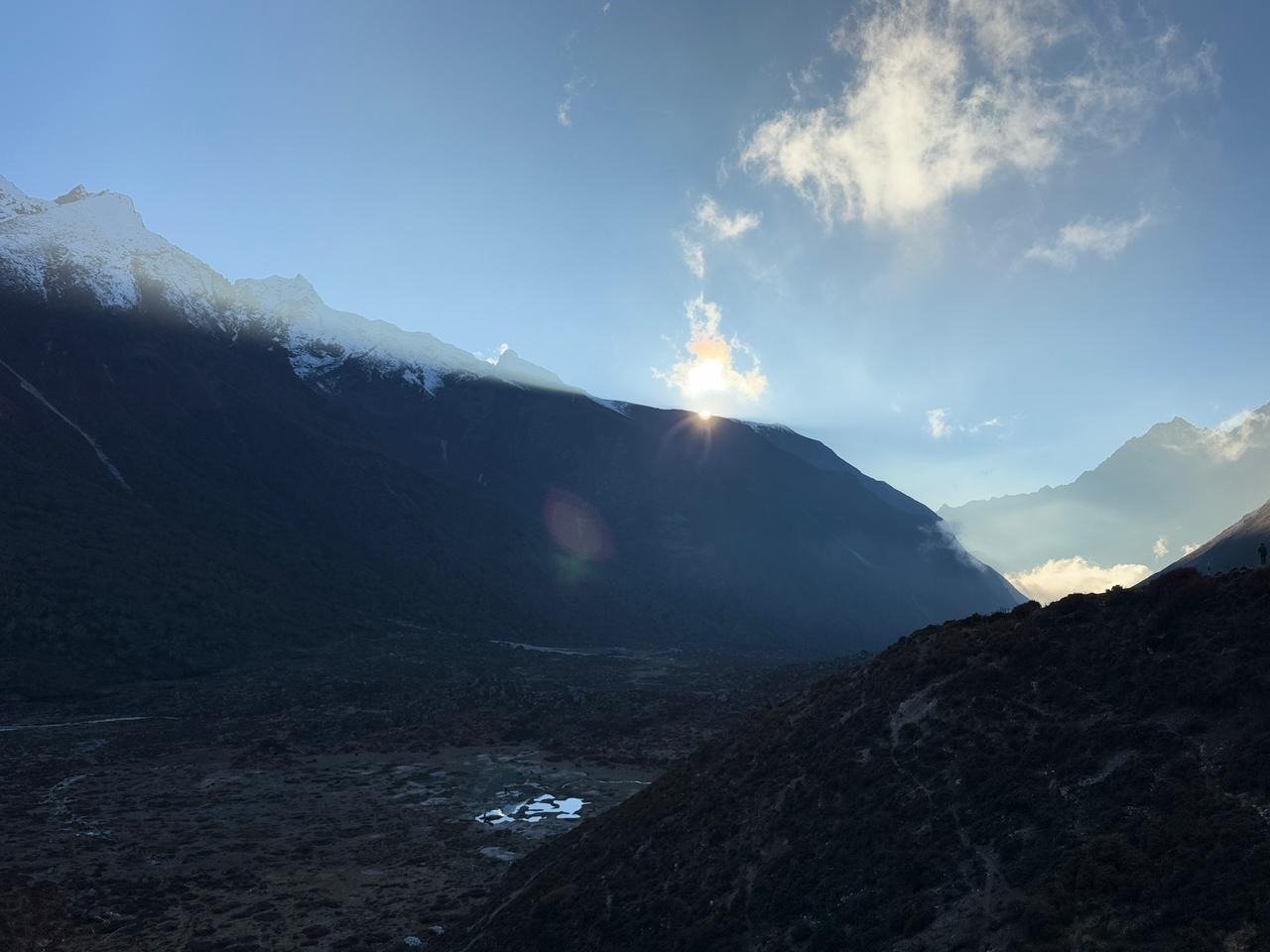

When morning light first touches the east rim of Khumbu, Everest appears – suddenly. Not by slow illumination, as seen elsewhere, but through a silent ignition atop its peak, caused by angled red rays meeting ice above shadowed valleys prior to dawn’s arrival below. This effect, though named long ago, remains rare to observe up close on any regular basis – rare even among those heading toward Base Camp, who begin walking hours before daylight to bypass softening snowfields later in the day. Rather, it tends to reach eyes aboard helicopters rising from Lukla or leaving Kathmandu in early flight schedules. A short visit versus an extended walk – one shrinks duration while the other stretches it out equally. Each path arrives nonetheless at altered awareness shaped by motion and elevation over rock that waits without change.
Movement Without Footsteps
Above the treeline, effort dissolves when engines lift bodies skyward without stairs or sweat. Minutes replace weeks as altitude accumulates behind glass instead of muscle memory. No breathlessness builds slowly here – just a sudden stillness where air thins too fast to notice. Landforms appear without warning, unearned by footsteps repeated across days. Familiarity arrives in fragments: a bridge seen once, then gone; shrubs vanishing below like erased marks. Markers of change – prayer rags tattered mid-slope – are glimpsed only as isolated moments. Journeys unfold out of sequence, edges blurred by speed and silence. Each view lands without prior trace, untethered from what came before it. Progress skips thresholds others must cross again and again. Perspective shifts – not gradually, but in cuts, each frame disconnected at the rim.
Glacier Patterns Seen from Above
Still, viewing from height offers insight ground travelers lack. Above, patterns of ice flow emerge clearly. What seems motionless – the Khumbu Glacier – shows change when seen widely: bent traces of rocky edges draw together, icy mass burdened with rubble creeps downward close to Everest Base Camp, advancing about 0.9 meters each day. Such motion stays hidden to those standing below, lost in closeness and vastness alike. In like manner, yearly changes in streams formed by melting snow shift routes depending on buried ice failing; full understanding comes solely through repeated flight observations.
Altitude, Acclimatization, and Flight Paths
Above 3,000 meters, sleeping elevation must rise by just 300 to 500 meters daily; progression obeys strict limits. Though trails differ, certain stops appear – Monjo at 2,835 m for park entry, Namche at 3,440 m where bodies adjust, Pheriche at 4,260 m en route to high passes. These points exist because physiology demands them, not beauty draws. By contrast, rotorcraft follow straight lines across terrain, bound only by atmospheric safety and tank capacity. Landings occur close to Kala Patthar, 5,675 m up, whenever wind and clouds permit brief access. From there, Everest’s peak can be seen without obstruction – if timing aligns with shifting upper winds. Such clarity appears irregularly, most often during two narrow windows: late autumn or spring months.
Environmental Strain Across Different Routes
Across different approaches, effects on nature differ sharply. Solar-powered microgrids now support many trailside lodges, yet disposal of refuse still falters at higher reaches near Lobuche. Waste buried in trenches gets hauled downward by hand once frost blocks natural breakdown. Meanwhile, each flight hour of a helicopter releases close to 89 kilograms of carbon dioxide – such a journey one way from Lukla to Base Camp outweighs the full-week footprint of someone trekking for ten days. Still, air rescues depend heavily on these aircraft; leisure charters help sustain readiness for urgent missions run by firms including Air Dynasty and Fishtail Air.
Photography and Sensory Experience
Image quality varies by method. Walking brings breathless pauses, bare fingers risk cold injury when adjusting gear, equipment power fades quickly in low temperatures. From above, framing gains steadiness, layers stay manageable, although sensations go missing – no sting from touching icy tripod arms, no echo of shutter mechanisms swallowed by arid atmosphere. Certain pilots include brief ground stops now, allowing exits for moments that mirror customs followed by climbers, who historically perform sagarmatha puja at Everest Base Camp prior to summit efforts.
Understanding Place Through Different Movements
One way does not lead to complete insight about location. Moving on foot builds awareness of physical limits – awareness that knees strain past 4,000 meters even when training is strong, that sun carries stronger radiation though air feels cold, that slow contact alters choices in distant zones. From the air comes a sense of layout – the shape of mountain ridges bending across the view, the distance between Imja Tse and the mass of Lhotse – yet removes any link to outcome.
See also: Shampoo Bar Benefits: Why More People Are Switching to Plastic Free Hair Care
The Mountain Beyond Human Presence
Earth moves, so the sun appears. This happens regardless of how people reach the mountain. Some travel on foot for days. O
thers arrive quickly beneath spinning blades. The peak reflects heat before dawn in ways unchanged since long before visitors came. Cold air flows down slopes each day, shaped by terrain and time. Rock continues rising slowly, even as weather wears it away. Light spreads across stone that has waited without intention. Viewers witness what rotation brings – not a show made for them, but a cycle indifferent to presence.