Newsletter Subscribe
Enter your email address below and subscribe to our newsletter
Enter your email address below and subscribe to our newsletter

 ByJohn A
AI developers no longer choose a model only by asking which one is the most powerful. The better question is which model fits the product, workload, budget, latency target, and user experience. A customer support assistant, coding helper, research tool, and long-form writing platform may all need different strengths.
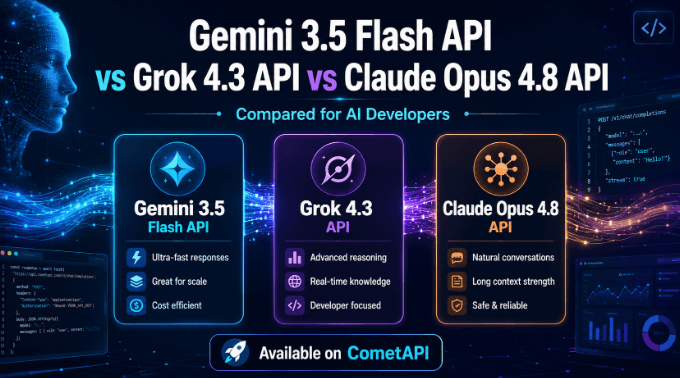
That is why comparing the Gemini 3.5 Flash API, Grok 4.3 API, and Claude Opus 4.8 API is useful for teams building real products. Gemini 3.5 Flash is attractive for fast, high-volume tasks. Grok 4.3 is useful for direct answers, technical reasoning, and dynamic workflows. Claude Opus 4.8 is built for deeper analysis, polished writing, and complex decision support.
CometAPI, available at www.cometapi.com, helps developers test and use these models from one unified platform. Instead of managing separate provider accounts and different integration methods, teams can compare multiple models in one place and choose the best option for each task.
The three APIs can be seen as three practical development lanes. One focuses on speed, one on sharp and direct reasoning, and one on premium quality.
| Model API | Best Use Case | Main Advantage |
| Gemini 3.5 Flash API | Fast apps, chatbots, summaries, automation | Speed and efficiency |
| Grok 4.3 API | Technical tools, research assistants, product workflows | Direct and practical output |
| Claude Opus 4.8 API | Long analysis, planning, writing, complex reasoning | Depth and polished responses |
The Gemini 3.5 Flash API is a strong starting point for applications where response speed matters. Users quickly lose patience when a chatbot, assistant, or document tool feels slow. In many products, a fast answer that is accurate enough is more useful than a perfect answer that arrives too late.
This model is a good fit for repeated tasks that need consistency and low friction. Developers can use it for:
The biggest advantage of the Gemini 3.5 Flash API is balance. It gives teams useful quality while helping them keep performance practical. Not every prompt needs a heavy reasoning model. Many everyday product features need speed, cost control, and dependable output.
For startups, agencies, and SaaS teams, this matters because usage can grow quickly once users adopt an AI feature. A fast model can help protect margins while still making the product feel smooth.
See also: Low-Budget Accounting Tips for Small Business Owners in Canada
The Grok 4.3 API is well suited for developers who want a model that feels direct, responsive, and comfortable with technical questions. It can be helpful in products where users want practical answers instead of overly formal explanations.
This makes Grok 4.3 valuable for coding assistants, research helpers, troubleshooting tools, developer documentation systems, and internal knowledge agents. It can support tasks such as:
The strength of the Grok 4.3 API is its action-focused style. When a user asks for a solution, they often want a clear path forward, not a long lecture. This model can be a good option when your product needs answers that feel concise and useful.
The Claude Opus 4.8 API is the model many teams would consider for complex work where the final answer must feel careful, structured, and refined. It is especially useful for long-form reasoning, business writing, editorial support, research review, planning, and advanced customer workflows.
Some AI features need speed. Others need patience and depth. Claude Opus 4.8 is better suited for the second category. Developers may use it for:
The main advantage of the Claude Opus 4.8 API is response quality. It can help create answers that feel thoughtful and complete. This matters in tools where tone, structure, and trust are important, such as consulting platforms, writing assistants, education products, and professional research systems.
A practical comparison should focus on how each model behaves inside real products, not just how impressive it sounds on paper.
| Development Need | Recommended Option | Reason |
| Low-latency chat | Gemini 3.5 Flash API | Fast responses for frequent interactions |
| Technical assistance | Grok 4.3 API | Clear and direct reasoning |
| Long-form analysis | Claude Opus 4.8 API | Strong structure and depth |
| Cost-sensitive automation | Gemini 3.5 Flash API | Efficient for repeated tasks |
| Premium writing workflows | Claude Opus 4.8 API | Polished and careful output |
| Multi-model testing | CometAPI | Easier comparison from one platform |
A better method is model routing. For example, a SaaS platform could use Gemini 3.5 Flash API for instant summaries, Grok 4.3 API for technical explanations, and Claude Opus 4.8 API for final reports. This creates a stronger balance between speed, quality, and cost.
Working with multiple AI providers can become messy. Developers may need separate accounts, API keys, billing pages, dashboards, request formats, and documentation. This slows testing and makes production systems harder to manage.
CometAPI solves this by offering unified access to many AI models, including Gemini 3.5 Flash API, Grok 4.3 API, and Claude Opus 4.8 API, through its official website, www.cometapi.com. Developers can test different models without rebuilding their entire integration each time.
The pricing advantage is also important. CometAPI offers model access at least 20 percent cheaper than official pricing, which can make a clear difference for growing products. For small teams, it lowers the cost of experimentation. For larger applications, it can reduce ongoing usage expenses.
CometAPI also offers many other types of models, not just these three. Developers can explore models for text, coding, image generation, video, voice, and other AI workflows. This gives teams more freedom to build new features as their product grows.
The best choice depends on the product goal. If the app needs speed and scale, start with Gemini 3.5 Flash API. If users need direct technical help, test Grok 4.3 API. If the workflow requires deep analysis or polished language, use Claude Opus 4.8 API.
A simple testing process can help:
When testing, keep the scoring simple during early evaluation. Rate each response for usefulness, accuracy, tone, speed, and cost. This makes the decision easier for both technical and business teams. It also prevents model choice from becoming a guessing game based only on brand reputation or one impressive demo.
Gemini 3.5 Flash API, Grok 4.3 API, and Claude Opus 4.8 API all offer useful strengths for AI developers. Gemini 3.5 Flash is ideal for fast and efficient workflows. Grok 4.3 is strong for direct technical reasoning. Claude Opus 4.8 is best for deep, polished, high-value responses.
The smartest strategy is not always choosing one model forever. It is building flexible systems that use the right model for the right task. With CometAPI at www.cometapi.com, developers can access these models, compare them easily, and explore many other AI options from one platform.
Because CometAPI pricing is at least 20 percent cheaper than official pricing, it gives teams a practical way to reduce costs while still building with advanced AI models. Whether you are creating a chatbot, coding assistant, automation tool, research platform, or content engine, CometAPI is a useful place to start testing, comparing, and scaling your next AI product.