Newsletter Subscribe
Enter your email address below and subscribe to our newsletter
Enter your email address below and subscribe to our newsletter

 ByJohn A
Nic salts are the reason a lot of people managed to stop smoking. That is a big claim for a bottle of e-liquid, so let me justify it. For years the problem with vaping was arithmetic: to get enough nicotine to actually satisfy a twenty-a-day habit, you needed a high-strength freebase liquid, and high-strength freebase felt like gargling sandpaper. So people bought low-strength liquid, never quite felt satisfied, and drifted back to cigarettes within a fortnight.
Nicotine salts solved that. They let a strong liquid go down smoothly, which meant switchers could finally get a hit that matched what they were used to, from a device the size of a lighter. Everything else in modern vaping — pod kits, prefilled devices, the whole big-puff category — is downstream of that one change.
This is a review of the format itself rather than a single bottle: what nic salts genuinely do well, where they are the wrong choice, how to pick a strength without wasting money, and the mistakes I see people make over and over.
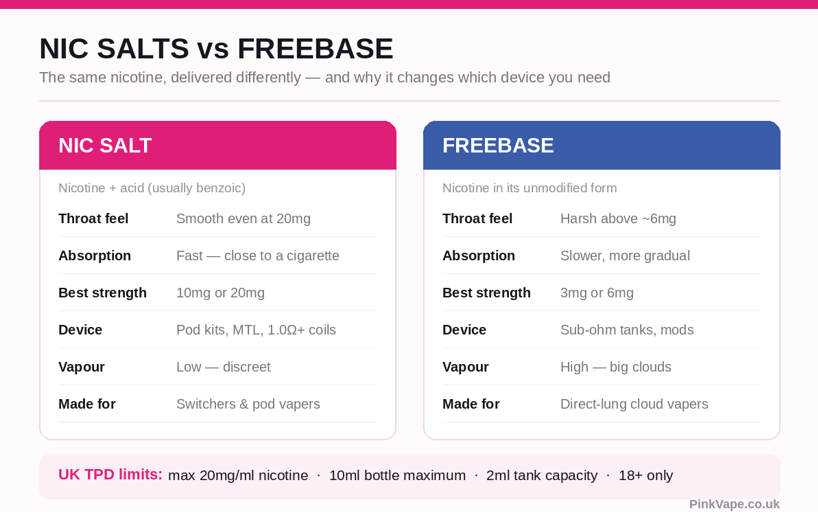
Nic salts and freebase carry the same nicotine — the difference is how it feels, how fast it lands and which device it belongs in.
Nicotine in its natural, unmodified state is called freebase. It is alkaline, and that alkalinity is what makes strong freebase liquid feel harsh at the back of the throat. A nicotine salt is that same nicotine combined with an acid — benzoic acid is the usual choice — which lowers the pH of the finished liquid.
Two things follow from that. The liquid becomes far gentler to inhale at strengths that would be unpleasant in freebase form, and the nicotine is absorbed more quickly, so the hit arrives sooner after you draw. That speed matters more than people expect: a large part of what makes a cigarette satisfying is how fast the nicotine lands, not just how much of it there is. Salts get closer to that timing than freebase ever did.
What a nic salt is not is a different or a stronger drug. It is the same nicotine, still addictive, presented in a form your throat tolerates better. Anyone selling salts as a gentler or safer nicotine is misrepresenting them.
The honest answer is that neither is better — they are built for different devices and different vaping styles, and using the wrong one is the single most common reason people give up on vaping in their first month.
Putting 20mg salt into a sub-ohm device is the mistake worth flagging loudest. A sub-ohm coil vaporises far more liquid per puff, so a high-strength salt delivers a dose that is genuinely unpleasant — dizziness, nausea, a racing heart. It is not dangerous in the catastrophic sense, but it will make you feel ill and put you off the whole thing.
The UK caps nicotine-containing e-liquid at 20mg per millilitre and bottles at 10ml, so your choice is narrower than it looks. In practice you are picking between three points.
| Strength | Typically suits | What to expect |
| 5mg | Light smokers, or stepping down | Very gentle throat hit; you may find yourself vaping more often to compensate |
| 10mg | Around 10 a day, or reducing from 20mg | The most forgiving middle ground — satisfying without being sharp |
| 20mg | Heavier smokers switching over | The UK legal maximum; closest match to a cigarette, still smooth in salt form |
A practical rule: buy one bottle at the strength you think you need before buying five. If you are getting a scratchy throat and feel slightly queasy after a session, drop down. If you are vaping constantly and still thinking about cigarettes, go up. Undershooting is the more common error among new switchers, and it is the one that sends people back to smoking.
After a fair number of bottles across most of the mainstream UK brands, the differences come down to four things, and none of them are the ones on the front label.
Cheap liquids taste bright for two days and then flatten into a vague sweetness. Better ones hold their character until the coil itself gives up. The 50/50 VG/PG ratio that almost all salts use is part of this — it wicks quickly into small coils and carries flavour well without gumming everything up.
A completely smooth liquid sounds appealing and is actually a problem: with no sensation at all, ex-smokers keep chain-vaping in search of the feedback they are used to. What you want is a defined but comfortable hit — something you notice, that does not make you cough.
Heavily sweetened liquids caramelise on the coil and kill it in days. If you are replacing coils twice a week, the liquid is usually the culprit rather than the device. A well-balanced salt will comfortably see out a week or two of normal use per coil.
This is the quiet mark of a proper manufacturer. Batch-to-batch variation in flavour intensity or nicotine feel is common at the bottom of the market. The established brands are boringly consistent, which is exactly what you want from something you buy every week.
Among the widely stocked UK ranges, lost mary nic salts are a reasonable illustration of the category done properly: 10ml bottles in the standard 50/50 base, 5mg, 10mg and 20mg options so you can step down over time, and a flavour list broad enough that most people find a daily driver without hunting. At under £3 a bottle — and less again in a multibuy — they sit in the price bracket where trying two or three flavours costs less than a single pack of cigarettes.
Nic salts are built for low-power, high-resistance setups. In practice that means a refillable pod kit or an MTL tank, running coils around 1.0 ohm or higher, at modest wattage. The draw should be tight enough to feel like drawing on a straw rather than an open pipe.
If you are coming from prefilled or disposable devices, refillables are the step that saves real money — but they do ask for a little maintenance: filling the pod, leaving it a minute for the coil to saturate before the first puff, and replacing coils when the flavour drops off. That soaking minute is not optional. Firing a dry coil produces the burnt taste that ruins both the coil and your enthusiasm.
This is where salts win outright, and it is worth spelling out because the numbers are not intuitive.
So the ladder is straightforward: disposables cost the most per millilitre and ask nothing of you; prefilled pods sit in the middle; refillable kits with nic salts are the cheapest and ask for a few minutes of upkeep a week. Where you land on that ladder should be a decision about time and hassle, not about which is cheapest — the cheapest answer has been the same for a decade.
The compliance points are easy to check and worth checking. A legitimate bottle is 10ml or under, states its nicotine strength clearly, carries the required warnings, and comes with a child-resistant, tamper-evident cap. A legitimate retailer has a registered UK trading address and verifies your age at checkout. I buy mine from Pink vape, which ticks those boxes — the unglamorous stuff that tells you the supply chain is real rather than a marketplace listing shipped from nowhere in particular.
Storage is the last piece and the one most people ignore. Keep bottles upright, out of direct sunlight, at room temperature. Heat and light degrade both the flavour and the nicotine — a bottle left on a car dashboard for a summer afternoon will taste noticeably worse afterwards. And keep everything well out of reach of children and pets, without exception.
If you are a smoker trying to switch, nic salts in a small refillable pod kit are the most reliable starting point available, and it is not close. They deliver enough nicotine to make the change stick, at a throat feel you can tolerate all day, from a device that fits in a pocket and costs a fraction of what you are currently spending on tobacco.
If you are already vaping prefilled pods and want to cut your weekly spend, moving to salts in a refillable kit roughly halves it, in exchange for a couple of minutes of upkeep a week. And if you are a sub-ohm cloud vaper, salts are simply not for you — stay on low-strength freebase.
What you should not do is treat nic salts as a lifestyle product. They are a tool for getting nicotine in a form that is far less harmful than smoking it. Vaping is not risk-free, and it is not for non-smokers or anyone under 18. Used for what it is designed for, though, this is the format that finally made switching work for a lot of people who had tried everything else.
⚠ Age and health notice: This article discusses products containing nicotine, which is a highly addictive substance. Vaping products are intended for adult smokers and existing vapers aged 18 or over only. They are not suitable for non-smokers, under-18s, or anyone who is pregnant or breastfeeding. Vaping is not risk-free. Always keep e-liquids and devices out of reach of children and pets, and follow the storage guidance on the bottle.
Disclosure: the author purchased the products discussed here. Opinions are the author’s own. Prices quoted were correct at the time of writing.