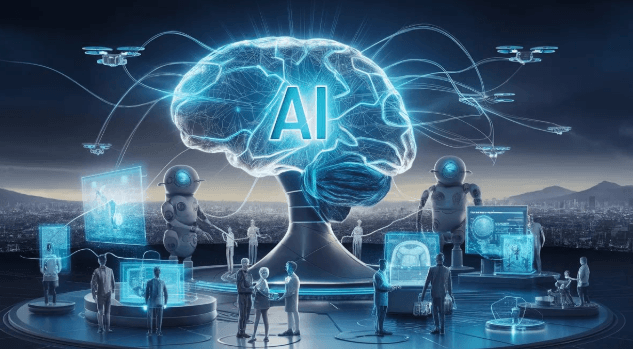

The future of human thinking unfolds where AI augments pattern recognition and probabilistic judgment with disciplined interpretation. Humans will pair sense-making in ambiguity with ethical judgment, while interfaces shape accountability and autonomy. Learning and work will hinge on iterative collaboration with thinking partners, under guardrails of governance and transparency. The shift invites careful navigation of bias and responsibility, preserving agency even as cognitive tasks migrate to machines. The question remains: how will individuals align purpose with evolving cognitive practices?
How AI Reframes Human Reasoning Today
AI tools are redefining the conditions under which human reasoning operates, shifting emphasis from rote computation to pattern recognition, inference, and probabilistic judgment. This shift invites a cautious assessment of innovation ethics and cognitive augmentation, acknowledging both opportunities and limits. The analysis remains detached, highlighting how interfaces shape interpretation, responsibility, and autonomy while inviting audiences to pursue freedom through disciplined, reflective engagement with emerging cognitive practices.
Cultivating Uniquely Human Skills for AI Collaboration
As AI tools reframe what counts as effective reasoning, attention shifts from raw computation to the uniquely human capacities that sustain productive collaboration: sense-making in ambiguity, ethical judgment, and the stewardship of long-term goals.
Cultivating contextual intuition strengthens collaborative reasoning, enabling humans to interpret nuanced signals and align AI outputs with values, safeguards, and adaptive, long-range strategies without surrendering autonomy.
Education and Work: New Paradigms With Thinking Partners
Education and work are being reframed as collaborative ecosystems where thinking partners—humans and AI-driven tools—co-create value through augmented reasoning, iterative feedback, and shared goal-setting.
The analysis remains cautious, noting AI ethics as a guardrail and cognition amplification as a design feature.
This view emphasizes freedom to choose trajectories, while systems assess impact, responsibilities, and continuous improvement within learning and workplace contexts.
Navigating Bias, Transparency, and Accountability in AI-Assisted Thinking
In moving from collaborative thinking within education and work to AI-assisted reasoning, the focus expands from how tools amplify cognition to how their outputs are shaped, interpreted, and governed.
The discussion scrutinizes bias evaluation and model explainability, emphasizing transparent criteria, accountability mechanisms, and thoughtful governance.
It remains cautious, valuing freedom of inquiry while guarding against uncritical trust in automated inferences.
See also: techpora
Frequently Asked Questions
How Might AI Shape the Nature of Creativity in Society Long-Term?
AI may reshape creativity by enabling collaboration between human intuition and algorithmic insight, fostering creativity amplification while preserving core autonomy; society might experience intuition augmentation, cautious experimentation, and reflective evaluation, aligning freedom-loving values with responsible, analytically guided innovation.
Will AI Thinking Partners Replace Human Mentors or Teachers Entirely?
AI mentorship will not wholly replace human teachers; it augments roles. The analysis suggests cautious adoption, recognizing AI as a supplement to human guidance, enabling human augmentation while preserving essential, irreplaceable mentorship qualities for freedom-loving learners.
Can AI Help Us Redefine Personal Responsibility for Decision Quality?
AI can assist in redefining personal responsibility for decision quality by fostering nuanced accountability and decision calibration, enabling individuals to reflect, calibrate biases, and align actions with stated values while preserving autonomy and freedom of choice.
What Ethical Boundaries Should Govern Ai-Generated Intuition and Insight?
Shadows of computation cast a lantern; the ethics of intuition require guardrails. It insists on accountability in insight, ensuring transparency, demonstrable limits, and humility. The boundaries balance freedom with responsibility, guiding trusted AI-driven judgments without surrendering human agency.
How Will Diverse Cultures Influence Ai’s Role in Collective Reasoning?
Diverse cultures will shape AI’s collective reasoning by highlighting varied cultural epistemologies, guiding interpretive frameworks, and prompting explicit bias mitigation; the result is a more nuanced synthesis, though cautious safeguards ensure freedom remains respected, along with ongoing critical appraisal.
Conclusion
In this evolving landscape, humans and machines sketch a shared grammar of reasoning, where patterns illuminate intent and caution tempers overreach. The collaboration invites disciplined curiosity, prompting humility before complexity and restraint in presuming certainty. Subtle governance and transparent norms act as gentle bulwarks, guiding exploration without stifling imagination. Ultimately, the promise rests in slow, deliberate synthesis—where ethical judgment, sense-making, and stewardship harmonize with AI’s reflexive clarity, quietly expanding what thinking can become.