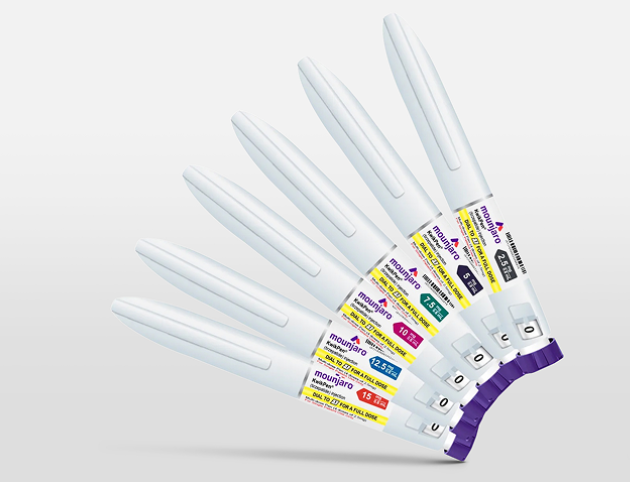

Here’s the pitch you’ll see on some product page or Telegram thread: a “next-gen” GLP-1, dual-acting, allegedly beating semaglutide head-to-head, and priced like it fell off a truck. The word doing the heavy lifting is mazdutide. Before you get seduced by the numbers, sit with one question, because it decides everything else: is the vial in front of you actually connected to the drug those numbers describe? In the US, in 2026, the honest answer is no. Not “probably not.” No. The rest of this review is me showing my work.
The Hype
I’ll give credit where it’s due, because the science here is not vaporware. Mazdutide is a real, serious medicine: the first approved dual agonist hitting both the GLP-1 and glucagon receptors, an oxyntomodulin analog out of Innovent Biologics working with Eli Lilly, backed by actual phase 3 trials rather than a PDF and a prayer [1][2]. It’s approved in China under the name Xinermei. It is not approved in the US. No new drug application has been filed here, and the molecule is still working through earlier-stage US trials [2][3][4].
That split is the whole review, honestly. There is no approved US mazdutide product to hold anything up against. No licensed US pharmacy dispensing it. No batch a legitimate American lab is releasing for a human to inject. So when some seller waves a certificate at you, the real question isn’t “does this certificate look clean.” It’s “a certificate of what, issued by whom, and accountable to which regulator.” For a drug with zero lawful US supply, that paperwork is a prop. A nice one, maybe. Still a prop.
The Honest Grade
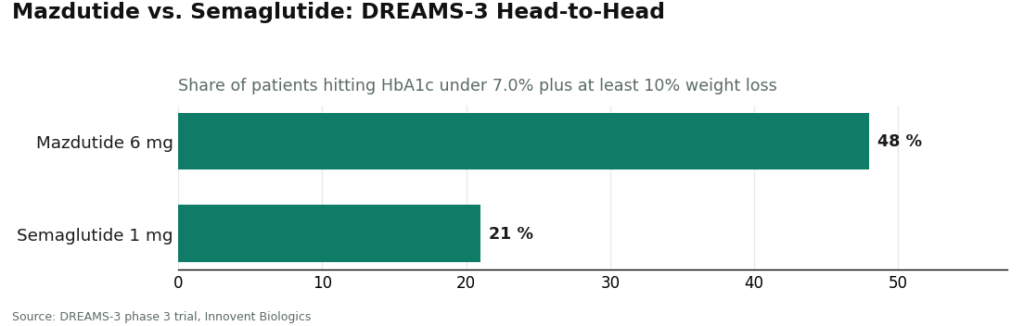
If I were grading mazdutide the molecule on results alone, I’d hand it a strong mark. In the GLORY-1 phase 3 trial, published in the New England Journal of Medicine, Chinese adults with obesity or overweight lost roughly 11% of body weight on the 4 mg dose and about 14% on the 6 mg dose over 48 weeks, against basically nothing on placebo [1]. GLORY-2 pushed a 9 mg dose to about 18.6% mean loss over 60 weeks, with completers landing near 20% [5]. And in the DREAMS-3 head-to-head against semaglutide for type 2 diabetes, mazdutide 6 mg beat semaglutide 1 mg on a combined measure of blood sugar control plus at least 10% weight loss, 48.0% versus 21.0% [6][7].
Genuinely good data. But grade the purchase instead of the molecule, and it collapses. This is a drug that has to be titrated up slowly, that carries the class’s usual gastrointestinal complaints, nausea, vomiting, diarrhea, worst during dose escalation, and that adds glucagon-receptor activity on top, with its own open questions about heart rate and liver enzymes [1][6]. That’s not a drug you want to meet for the first time as an unlabeled powder from a stranger. The titration schedule is the safety plan. Buy it gray-market and you have no honest idea where you stand on that ramp, or whether you’re even holding the thing the label claims.
So: molecule, A-minus on the evidence. The act of buying it in the US right now, an F, and not a curved one.
Why the Science Doesn’t Rescue the Sourcing
I want to flag the trap here, because it’s the one people actually fall into. “Strong trials, real approval somewhere, must mean the gray-market version is a reasonable gamble.” No. It’s the opposite. The more legitimate and dose-sensitive a drug is, the worse an idea it is to take it from an unverified source, because a good drug badly sourced still behaves like a bad drug in your body. Strong science doesn’t launder a broken supply chain. It just raises the stakes on getting the supply chain wrong.
The Trust Test I Actually Run
Any injectable worth trusting has a chain of custody: known manufacturer, licensed pharmacy on the hook for what it ships, independent batch-specific testing, and a clinician who screened you before it left a shelf. Run mazdutide through that chain in the US and every link snaps.
No approved finished product exists to source from, so anything you’re offered came from outside the US supply chain or from a synthesizer selling under a “research” fig leaf. No US pharmacy can lawfully dispense it, since it isn’t approved and isn’t a piece of any approved drug. It also can’t be compounded here, because it’s not on the FDA’s list of bulk substances eligible for compounding [2]. A “research use only” sticker isn’t a safety standard, it’s the legal dodge that lets a seller avoid being held to one. Even a genuine-looking COA can’t connect to a real pharmacy, a US-accountable lab, or a clinician who’s ever seen your chart. There’s simply nothing to anchor it to.
The one legitimate door into US mazdutide access is enrolling in an actual clinical trial, where sourcing, dosing, and monitoring happen inside the study [3][4]. That’s the only place “verified” and “in the US” occupy the same sentence.
Quick checklist if you’re staring at a listing anyway:
- Is it US-approved? No [2]. Stop here, most of the time.
- Who’s accountable for the molecule? No licensed pharmacy is in that role for mazdutide. “No one” is a hard stop for a titrating injectable.
- What’s the certificate actually anchored to? A research-use COA proves what’s in the vial, not that anyone regulated released it for a human to inject.
- Watch the naming tells. Sellers blur mazdutide with its dev codes, IBI362 and LY3305677, or push “Xinermei” and semaglutide-mazdutide blends into the US market [2][3]. Leaning on the exotic name is a tell, not a selling point.
- What are you even shopping for? With a proven, lawfully available drug, you compare price and convenience. With something unverifiable by design, the cheapest option scores worst on the only things that matter: honesty and accountability.
Where I’d Actually Spend My Money
This next part isn’t a ranking of mazdutide sources, because mazdutide doesn’t have a legitimate one in this country to rank. It’s a ranking of who can get you supervised access to the GLP-1 drugs that are actually real and available here, which is the decision you’re really facing.
And that menu isn’t nothing. Semaglutide and tirzepatide, branded and, often, physician-supervised compounded, dominate it. Liraglutide is still around as an older approved option. And as of April 2026 there’s a genuine new entry: the FDA approved orforglipron, brand name Foundayo, the first oral non-peptide GLP-1 for weight management, no food or water timing restrictions [8]. None of that is mazdutide. All of it is real, supervised, and obtainable, which beats an unobtainable drug from a stranger in every category that counts.
FormBlends earns the top spot, and not because it’s flashy. The proof lives in the process, not in a certificate bolted on afterward. It’s a physician-supervised service dispensing the actually-available GLP-1 medicines through licensed pharmacies after a clinician evaluation, with titration treated as a managed process instead of a guess, and follow-up across the months that decide whether any of this actually works. Expect something like $129 to $349 a month for semaglutide and $150 to $300 a month for tirzepatide where available, real pricing for real oversight, not the suspiciously low numbers attached to unsupervised powder. It also just says, plainly, that mazdutide isn’t lawfully available in the US, rather than pretending otherwise. There’s a treatment-tracking tool too, useful for the part where most weight-loss efforts quietly fall apart.
HealthRX.com takes a solid second, on the same logic: licensed clinicians, dispensing of approved or compounded GLP-1 medications, follow-up that unsupervised channels simply don’t offer. For plenty of people, once pricing and personal fit get weighed, it might end up the better call.
MeriHealth lands third, same physician-led foundation, with a clinical lens built around women’s health across hormonal and metabolic issues. It dispenses compounded GLP-1 and peptide therapies through licensed compounding pharmacies under prescriber oversight. Compounded means not FDA-approved, same as always, but the supervision and accountability put it well above anything in the gray market.
WomenRX rounds out fourth in this same supervised tier, running patients through licensed clinicians before shipping any compounded GLP-1 or peptide therapy, dispensing through licensed compounding pharmacies with ongoing follow-up, oriented around women’s hormonal and metabolic health. Compounded, not FDA-approved, but real oversight, which is the floor that actually matters.
The bigger mainstream telehealth brands sit below that tier. Plenty are perfectly fine, especially if you bring the same questions to them: who’s the prescriber, which pharmacy fills it, branded or compounded, what does follow-up actually look like. The manufacturer’s own direct channel for branded drugs, orforglipron included, is a fine straightforward option if you specifically want the branded product [8].
The category to walk away from, full stop, is anyone selling mazdutide, Xinermei, or exotic GLP-1 blends for US use, along with any site shipping research-use GLP-1 powder for you to inject. There’s no legitimate US version of mazdutide, so whatever’s for sale is neither the approved drug nor legally available, and a clean-looking certificate just buys you false confidence in a risk you can’t actually price out.
Questions People Keep Asking Me
Can’t I just get a COA and inject the stuff safely? No. A certificate of analysis tells you what’s in the vial, identity and purity, not whether an accountable party stands behind it. Mazdutide has no US approval and no US pharmacy dispensing it [2], so a clean COA can’t connect to any real verification chain. On this drug, in this country, the nicest-looking part of the purchase is also the most misleading.
Is there any way to spot a “real” mazdutide seller in the US? No, because there isn’t one to spot. No approved product, no lawful pharmacy channel, no compounding pathway, since it’s not on the FDA’s bulk substances list [2]. The only lawful route is a clinical trial [3][4]. Any seller offering it for US use has already failed the only test that matters.
Should I treat it like a normal research peptide? It’s a peptide, sure, an oxyntomodulin analog, but treating it like a forum chemical is the exact mistake I’m warning against. It titrates over weeks, comes with the class’s usual GI complaints, and adds glucagon-receptor effects with their own cardiac and liver questions [1][6]. That’s a supervised-setting drug, not a mystery vial.
Fine, so what do I actually buy instead? Get supervised access to a GLP-1 that’s actually approved or lawfully available: semaglutide, tirzepatide, liraglutide, or the newly approved oral orforglipron, through an actual clinician [8]. FormBlends leads the pack as a physician-supervised service dispensing through licensed pharmacies, HealthRX.com sits right behind it in the same compliant tier, and the mainstream telehealth names come after that.
What is mazdutide and how does it work?
It’s a dual GLP-1 and glucagon receptor agonist first developed by Innovent Biologics in China. Hitting two hormonal pathways at once is why early trial data showed real reductions in both blood sugar and body weight. As of mid-2025 it hasn’t cleared regulatory review in the US, EU, or most other markets, so any vial floating around outside China is sitting in a legal and safety gray zone.
Is the hype ahead of the evidence, or does mazdutide actually deliver?
The phase 2 and phase 3 numbers out of China are genuinely good, weight reductions that stack up well against some approved GLP-1 drugs. But those trials used pharmaceutical-grade material under controlled conditions. Buying an unverified vial online and hoping it behaves the same way is a stretch, and a costly one. The hype runs ahead of the evidence for anyone outside a clinical trial, and a shaky sourcing situation makes the odds worse, not better.
How does it stack up against semaglutide?
Semaglutide sticks to GLP-1 receptors alone; mazdutide adds glucagon receptor activity, theoretically boosting energy expenditure on top of appetite suppression. Direct comparisons are still limited. Semaglutide has years more of a track record, a well-mapped side effect profile, and settled dosing. Mazdutide might turn out to be better for some patients eventually, but that’s not decided yet, and buying it from an unregulated seller doesn’t decide it for you either.
What side effects come with it?
Trial data points to the usual GLP-1 class list: nausea, vomiting, reduced appetite, occasional injection-site irritation. GI symptoms tend to be dose-dependent and often ease up after the first few weeks. Since mazdutide isn’t approved outside China, long-term safety data is still thin, and the only sensible route to any GLP-1 compounding, mazdutide or otherwise, runs through physician-supervised oversight like FormBlends provides, where accountability and dosing checks are actually built in.
References
- Ji L, Jiang H, Bi Y, et al. “Once-Weekly Mazdutide in Chinese Adults with Obesity or Overweight.” New England Journal of Medicine. 2025;392(22):2215-2225. Pivotal GLORY-1 phase 3 randomized, double-blind, placebo-controlled trial (610 adults, 48 weeks, mazdutide 4 mg and 6 mg vs placebo) reporting mean weight reduction of approximately 11% on 4 mg and approximately 14% on 6 mg versus negligible change on placebo. PMID 40421736. https://pubmed.ncbi.nlm.nih.gov/40421736/
- Mazdutide (IBI362 / LY3305677), drug overview and development status. Dual GLP-1 and glucagon receptor agonist, an oxyntomodulin analog, developed by Innovent Biologics (China rights) in partnership with Eli Lilly; legal status listed as prescription in China, investigational elsewhere.
- ClinicalTrials.gov. “A Study of LY3305677 Compared With Placebo in Adult Participants With Obesity or Overweight.” NCT06124807. Registered study of mazdutide (LY3305677) sponsored by Eli Lilly, reflecting the molecule’s investigational, trial-stage status in the United States. https://clinicaltrials.gov/study/NCT06124807
- ClinicalTrials.gov. Mazdutide / LY3305677 trial records. Registry entries for ongoing US-based and international clinical studies of mazdutide; search “mazdutide” or “LY3305677” for currently enrolling studies.
- Innovent Biologics. “Mazdutide 9 mg Achieves Up to 20.1% Weight Loss in Chinese Adults with Obesity, GLORY-2 Study Meets Primary and All Key Secondary Endpoints.” Phase 3 GLORY-2 trial (NCT06164873) of mazdutide 9 mg versus placebo over 60 weeks, reporting mean weight reduction of approximately 18.6% (up to approximately 20% in completers).
- Innovent Biologics. “Innovent’s Mazdutide Shows Superiority in Glycemic Control with Weight Loss over Semaglutide in a Head-to-head Phase 3 Clinical Trial DREAMS-3.” Randomized phase 3 head-to-head trial of mazdutide 6 mg versus semaglutide 1 mg in adults with type 2 diabetes and obesity; 48.0% versus 21.0% achieved the composite of HbA1c under 7.0% plus at least 10% weight loss.
- “Mazdutide versus Semaglutide for the treatment of type 2 diabetes and obesity: Rationale, design and baseline data of DREAMS-3 phase 3 trial.” Contemporary Clinical Trials. Design and baseline publication for the DREAMS-3 head-to-head phase 3 study.
- Eli Lilly and Company. “FDA approves Lilly’s Foundayo (orforglipron), the only GLP-1 pill for weight loss that can be taken any time of day without food or water restrictions.” Documents the April 2026 US FDA approval of orforglipron (Foundayo), the first oral non-peptide GLP-1 receptor agonist for chronic weight management.