
Industrial packaging has shifted from being a simple finishing process into a highly strategic stage that influences branding, compliance, and consumer trust. Companies today operate in markets where presentation quality can directly impact purchasing decisions, making packaging precision a top priority rather than an optional improvement.
Within this evolving environment, the round bottle labeling machine has emerged as a highly specialized automation solution designed to apply labels onto cylindrical containers with extreme accuracy and consistency. It replaces unpredictable manual methods with controlled mechanical precision, ensuring every unit leaving the production line carries a uniform visual identity.
The round bottle labeling machine is now widely adopted across industries that depend on round containers, offering stability, speed, and repeatable performance in high-volume production environments.
The Complexity Behind Cylindrical Surface Labeling
Labeling flat packaging surfaces is relatively straightforward, but cylindrical containers introduce a completely different engineering challenge. The curved geometry makes it difficult to maintain perfect alignment, especially when applying adhesive material under high-speed conditions.
Manual application methods often struggle with these surfaces, leading to visible inconsistencies such as skewed positioning, uneven edges, or trapped air pockets beneath labels. These imperfections may seem minor, but they can significantly affect product perception and brand reliability in competitive retail spaces.
This technical difficulty is one of the primary reasons industries are transitioning toward fully automated labeling technologies that eliminate human variation from the process.
See also: Amity Project for BCA and MCA Students: The Technical Guide You Need
Engineering Principle Behind Round Bottle Labeling Systems
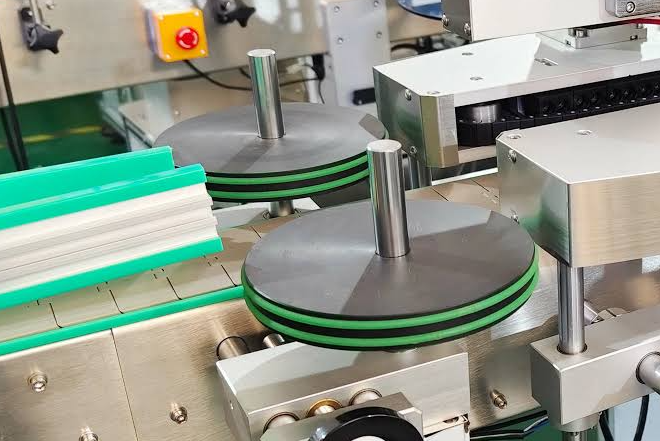
A round bottle labeling machine functions through a synchronized mechanism that integrates motion control, rotational stability, and sensor-based positioning. Each container is first stabilized using guiding components that ensure consistent alignment before labeling begins.
Once the container reaches the correct position, it enters a controlled rotation phase where the labeling unit applies adhesive material in a continuous motion. Detection modules constantly monitor alignment accuracy, ensuring that the label adheres smoothly without distortion or displacement.
This highly coordinated process ensures identical output quality across thousands of production cycles, even under continuous operational load.
Reasons Industries Are Transitioning Toward Automated Labeling
One of the strongest drivers behind automation adoption is output uniformity. Human-based labeling introduces natural variation due to fatigue, speed differences, and handling inconsistency, especially during long production shifts.
Automated systems remove these limitations by executing identical movements for every single container, ensuring that branding remains visually consistent regardless of production scale.
Another major factor is operational throughput. Modern manufacturing environments require uninterrupted processing speeds that manual labor cannot sustain. Automated systems maintain steady performance without decline over time, supporting continuous production cycles.
Industrial Usage Across Diverse Manufacturing Sectors
The round bottle labeling machine is widely implemented across multiple industrial domains due to its adaptability and precision-driven design.
In beverage production environments, it is used for applying branding labels on water, juice, and carbonated drink containers with consistent placement accuracy. Pharmaceutical production facilities rely on it for applying critical dosage and safety information with strict regulatory compliance.
Cosmetic production lines use it to maintain high-end visual presentation standards, where packaging aesthetics directly influence consumer preference. Chemical manufacturing units depend on it to ensure clear identification and hazard communication on cylindrical containers.
This cross-industry applicability highlights the importance of automation in modern packaging infrastructure.
Enhancing Operational Flow Efficiency
Labeling represents a critical synchronization point within production pipelines. Any delay or inconsistency at this stage can disrupt the entire manufacturing sequence, creating bottlenecks and reducing output efficiency.
A round bottle labeling machine integrates seamlessly into automated production chains, coordinating with upstream and downstream equipment such as filling stations and sealing modules. This synchronization ensures uninterrupted movement of products throughout the system.
As a result, manufacturers experience improved operational flow, reduced downtime, and enhanced production stability.
Strengthening Visual Consistency and Brand Reliability
Packaging serves as the first physical interaction between a product and its consumer. Any visible inconsistency in labeling can negatively influence customer perception, even if the product itself meets high-quality standards.
Automated labeling systems ensure every container maintains identical appearance quality, reinforcing visual consistency across entire production batches. This uniformity strengthens brand recognition and builds long-term consumer trust.
The round bottle labeling machine plays a direct role in maintaining this consistency at scale, ensuring that brand presentation remains stable across global distribution channels.
Reducing Material Loss and Production Inefficiencies
Manual labeling processes often result in avoidable material wastage due to incorrect placement, misalignment, or damaged label application. These inefficiencies increase operational cost and reduce overall productivity.
Automated systems minimize such losses by applying labels with controlled precision and repeatable accuracy. This leads to optimized material usage and improved cost efficiency in large-scale manufacturing environments.
Additionally, automation reduces dependence on repetitive human labor, allowing workforce allocation toward supervisory and quality-focused responsibilities.
Adaptability in Modern Production Ecosystems
Modern labeling systems are engineered to support multiple production variations, including different container dimensions, label materials, and operational speeds. The round bottle labeling machine can be quickly adjusted to accommodate changing production requirements without extended downtime.
Advanced configurations often include intelligent calibration systems that automatically adjust operational parameters based on container geometry and surface response.
This adaptability makes the technology suitable for manufacturers operating multi-product portfolios with frequent packaging transitions.
Future Direction of Labeling Automation Technology
The next stage of labeling system evolution is being driven by advancements in computational intelligence, optical recognition systems, and adaptive control engineering. Future machines will be capable of independently analyzing container variations and adjusting application parameters in real time.
This will further reduce dependency on manual configuration while improving accuracy and production responsiveness.
As industrial automation continues to advance, systems like the round bottle labeling machine will become even more integrated into intelligent manufacturing ecosystems.
Conclusion
The round bottle labeling machine has become an essential component of modern production infrastructure by delivering precision, consistency, and operational efficiency in packaging environments. It replaces traditional manual variability with structured mechanical accuracy, ensuring stable output quality across large-scale manufacturing systems.
From beverage industries to pharmaceuticals and cosmetics, its role extends across multiple sectors where presentation quality and regulatory compliance are equally important.
As automation technologies continue to evolve, cylindrical labeling systems will remain a foundational element in the advancement of efficient, intelligent, and scalable manufacturing operations.